
The first horses Kateryna draws cannot be stroked or ridden. They exist only on old postcards and in yellowing magazines. She was born in the southern Ukrainian city of Mykolaiv, when her homeland was still a Socialist Soviet Republic. In 1991, the familiar system collapses, and uncertainty takes its place. The idea of an invincible socialism had given many people a sense of stability. Suddenly, an entire generation wakes up in a world that no longer exists. Those in charge disappear; factory gates remain closed. Hope is scarce — as scarce as money.
“Horse posters, the kind Western girls casually pinned to their bedroom walls, were almost impossible to find where we lived,” she recalls. “So I copied the few images I could find, simply to preserve them.” Real encounters remain rare. The longing only grows stronger.

With her teenage years comes independence, and the chance to get close to the animals she loves most. In the local stables, Kateryna sweeps the aisles, feeds the horses, mucks out the stalls and helps wherever she is needed. And she rides. But it is not rosettes or prize ceremonies that drive her. “What I loved far more is simply being with horses, watching them and studying their behaviour,” she says.
What begins as childlike fascination becomes a life path. Kateryna studies animal science and devotes both her bachelor’s and master’s theses to the breeding of Trakehner horses. Eventually she takes up a position at Mykolaiv Zoo. Unlike many Western zoos, the research and visitor centre houses not only exotic species but also native wildlife and domestic animals. Kateryna becomes a senior scientific researcher and takes responsibility for the horses. At the same time, she continues her studies at doctoral level. And she keeps painting.

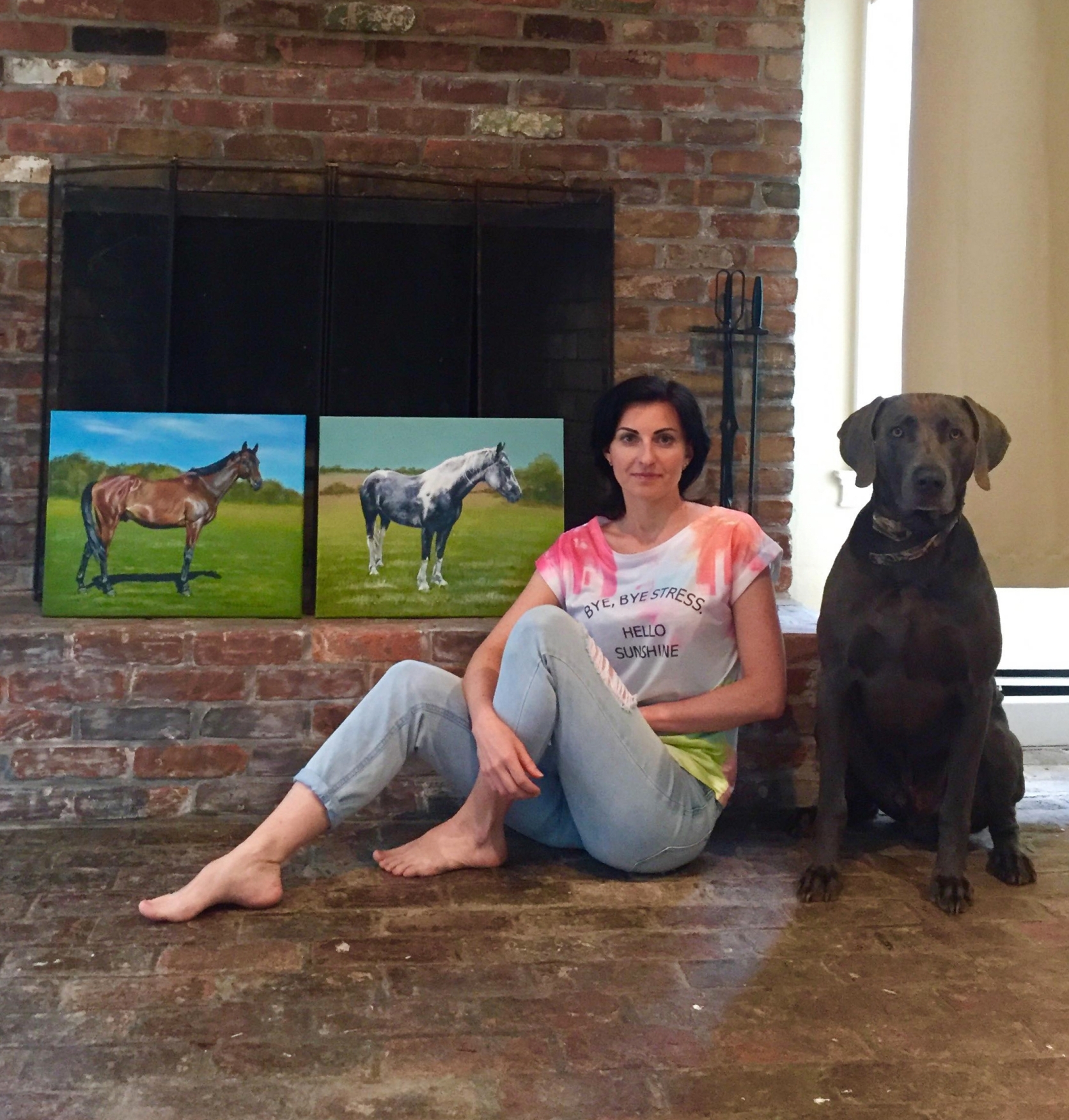
Her scientific knowledge of anatomy sharpens her eye for conformation. But her paintings are more than technically precise. They capture the alertness in a horse’s gaze — its dignity and presence. Rhythm, texture and light shape her work. Acrylic, oil, gouache, ink: the medium follows the expression of the horse.“I want to show the physical integrity of each horse as well as its personality,” she stresses.
As a self-taught artist, she begins to build a reputation. Riders and breeders in Ukraine ask her to paint their horses; later, stud farms in Europe and the United States commission her work as well. Kateryna’s paintings hang in private collections there, far from the upheaval that is about to shatter her world once again.
Painting amid constant attack
On 24 February 2022, Russia invades Ukraine. Mykolaiv, on the Black Sea, is strategically important and comes under constant attack — from land, sea and air. Many people flee; others stand frozen in disbelief. Some leave their animals behind because they have no choice, or because they simply do not care. Horses, too, are evacuated: flight animals under falling bombs, every metre a test of nerves.
Kateryna leaves the city where she built her life. A Friesian breeder friend in Germany offers her refuge, but she declines. A wounded homeland is still a homeland. Instead, she flees to Drohobych in western Ukraine. Nearly a thousand kilometres now separate her from the front line. Russian medium-range missiles can reach the region in less than ten minutes, striking residential areas and infrastructure. Kateryna continues to paint– sometimes without heating and electricity.
“I began to bring more light into my colour palette.”
Painting remains a constant, and a way of resisting despair. “The war has forced me to change,” she says. “I have begun to explore new media, especially watercolour, to bring more light into my palette. My art now seeks healing and humanity, while also becoming a form of resistance.” In a post, the Equis Art Gallery in Red Hook, New York, highlights Kateryna and other artists they represent working under the constant threat of danger.

The feeling of not being forgotten by the world strengthens her mental resilience and helps her help others survive. Kateryna donates part of the proceeds from her art sales to animals affected by the war. She supports wounded soldiers in finding their way back to life through equine therapy, and hopes that one day she will be able to return to her hometown. It would be yet another new beginning in a world that had once felt familiar.